Change Address

VOTE411 Voter Guide

Wisconsin Assembly, District 23/Asamblea de Wisconsin, Distrito 23

Wisconsin Legislative BranchWisconsin’s legislature makes state laws. The legislature has two houses: the Wisconsin Senate and the Wisconsin Assembly. Proposed laws (bills) can originate from either the state senate or assembly. Both houses must approve the bill before it is passed on to the governor for signature or veto. The legislature can override a veto with a two-thirds majority vote in each house. The legislature controls the spending of state funds through appropriation.Wisconsin AssemblyThe Wisconsin Assembly has ninety-nine representatives. Voters elect representatives to represent their assembly district for a two-year term. There is no term limit.__________Poder Legislativo de Wisconsin La legislatura de Wisconsin produce las leyes estatales. La legislatura consta de dos cámaras: el Senado de Wisconsin y la Asamblea de Wisconsin. Las propuestas de ley pueden originarse tanto en el Senado estatal como en la Asamblea. Ambas cámaras deben aprobar el proyecto de ley antes de transmitirla al gobernador para su firma o veto. La legislatura puede anular un veto con un voto mayoritario de dos tercios en cada cámara. La legislatura controla el gasto de los fondos estatales a través de las leyes de asignación. Asamblea de WisconsinLa Asamblea de Wisconsin tiene noventa y nueve representantes. Los votantes eligen representantes para representar a su asamblea de distrito por un término de dos años. No hay límite de términos.Nota: Las respuestas de los candidatos que aparecen en español se tradujeron de las respuestas originales de los candidatos en inglés.

Click a candidate icon to find more information about the candidate. To compare two candidates, click the "compare" button. To start over, click a candidate icon. To rank a candidate, click the "rank" button.

Ranked Candidates

{_getRcvHelpLabel()}

All Candidates

  • Candidate picture

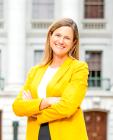
    Deb Andraca
    (Dem)

  • Candidate picture

    Aleaner Pabonnie
    (Rep)

Biographical Information

Please describe your priorities for your term in office and your specific qualifications to effectively address those issues.

What do you see as the most pressing housing-related issue in Wisconsin, and what policies, if any, would you support to address the issue?

What redistricting process, if any, do you believe the legislature should put in place before the next national census to ensure fair representation for voters?

What, if anything, will you do to ensure our schools have the resources to improve outcomes for its students, including those with disabilities?

What guardrails, if any, would you support to protect our environment, health, property values, and household budgets from large projects such as hyperscale data centers and Concentrated Animal Feeding Operations (CAFOs)?

Committee Friends of Deb Andraca
Campaign Email info@debforwi.com
Campaign Phone 414-485-5284
Campaign Twitter Handle @debforwi
Education B.A. Syracuse University, 1992; M.A. George Washington University, 1996; completed teacher licensure program at Alverno College, 2018.
Personal Pronouns she/ her
If re-elected, I will build on my three terms of legislative experience and my work on the Joint Finance Committee to advocate for policies that make Wisconsin safer, smarter and healthier. These include common-sense gun safety legislation, increased funding for public schools and special education, affordable healthcare and childcare, legislation to reduce costs for Wisconsin families, and protecting reproductive rights. As a former elementary school teacher and parent of two college-aged children, I understand the importance of a quality education and how families are struggling to afford college, groceries, rent and gas.
Affordability is the most urgent housing issue in Wisconsin. According to the Wisconsin Policy Forum, the median sales price of homes in Wisconsin increased by more than half (53.3%) in just five years, while the state’s median household income increased by only 19.7%. Fixing this problem will require a combination of streamlining the permitting process to get homes built more quickly, easing zoning restrictions to encourage more multi-family and high-density housing, and providing subsidies, tax abatements and grants to encourage developers to build affordable units.
I have been a long-time advocate for fair maps in our state. Wisconsin made a big step in the right direction when Wisconsin’s gerrymandered maps were ruled unconstitutional by the Supreme Court. However, even with more balanced maps signed into law by the Governor, without a better redistricting process in place we risk returning to gerrymandered maps once again. I support an independent, nonpartisan redistricting process that creates maps that reflect the state electorate, not the wishes of any candidate or political party.
Wisconsin’s education funding formula is broken. As a member of the Joint Finance Committee I led the fight for sustainable, predictable public education funding indexed to inflation and increasing the special education reimbursement rate during the last budget cycle. School districts are required to provide special education services to students and these costs, like most other expenses, have been rising sharply. We need to cap participation and bring more transparency to the school voucher system, revisit the ideas from the Blue Ribbon Commission on School Funding, and build on this bipartisan foundation to create a student-centered school funding model that meets every student’s needs.
The public deserves more input into large industries that could have an impact on our health, environment, water resources, and electricity grid. I was a co-sponsor of AB 722 which would have regulated data centers by establishing a very large customer utility rate, requiring renewable energy as part of the centers’ energy use, restricting water use and encouraging the use of local labor and businesses for construction and maintenance. Unfortunately, the Republican-controlled state legislature failed to pass any meaningful legislation to help regulate these industries. Projects with enormous size and scale should not be allowed to simply overwhelm local residents and municipalities just because they have the resources to do so.
Candidate has not yet responded.