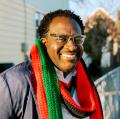
Experience and Qualifications
President, St. Albans Civic Improvement Association • Second Vice President, Southeast Queens Residents Environmental Justice (SQREJ) Coalition • Board member, Southeast Queens Center for History and Culture.
Community Involvement
Treasurer, Caribbean American Repertory Theatre (CART) • Board member, Green Ready Alternative Energy Program (GRAEP)
Education
MBA Finance, Fordham University Graduate School of Business • BBA Finance, CUNY Baruch College
Party Endorsements
New York Working Families Party (NY WFP)
Campaign Phone
7185502913
Campaign Instagram
instagram.com/osterforus/
Campaign YouTube
(1) Tax the rich so that we can make NY affordable for all, especially in housing, health care, child care, and elder care.
(2) Address governmental forms of institutional racism that have resulted in displacement of residents, instances of environmental injustice, and under-investment in the public infrastructure of the 33rd Assembly District.
(3) Ensure clean air and water for all.
There are dozens of policies that NYS must adopt in order meet the challenges being posed by climate change; the most beneficial policies to prioritize are those that will (1) realize and speed up a complete statewide transition to renewable energy sources; (2) maximize the state's ability to provide clean energy directly to both individuals and organizations; and (3) minimize the role of for-profit companies in implement this transition.
The manifestations of social and racial injustice are everywhere, from the hospitals in which babies are born to the care facilities in which many of our elders spend their final days.
Addressing the many forms of social & racial injustice prevalent in our daily lives will require constant and proactive intervention by New York State government in most policy areas, from housing to healthcare, from education to the environment, and from our workplaces in offices to our workplaces in warehouses. In all of these areas, our policies and budgets must provide justice for the most marginalized—including Black & Brown people, immigrants, disabled people, LGBTQ people, and, last but not least, poor people.
While there are too many worthy policies to name in this very small space, there is one policy I will single out here: namely, my support for state-level reparations, which aims to address that longstanding racial injustice with which our nation still has not yet fully reckoned.
There are dozens of actions that New York State can take to counteract the effects of the Callais decision.
First and foremost is to reform our state's electoral system so that the concerns and demands of Black voters—as well as those of voters from other marginalized communities—actually matter.
Currently, the two-party duopoly allows Democrats to take Black voters' votes for granted without providing much in return; this is what's known to political scholars as the problem of "capture."
The way out of capture lies in creating a true multi-party system, which would give Black voters (and voters from other marginalized communities) the power to force both major parties to earn their votes. The best path to creating a multi-party system lies in strengthening fusion-voting, expanding ranked-choice voting to all elections, and then adopting methods to implement proportional representation for elective legislative bodies.
Candidate has not yet responded.
Candidate has not yet responded.
Candidate has not yet responded.
Candidate has not yet responded.